

Why have fixed interest investments struggled?
Fixed interest has faced a challenging period. Persistent inflation, rising energy prices, uncertainty about how high interest rates need to go to contain inflation, and resilient economic activity have pushed global interest rates and bond yields higher, weighing on returns from an asset class generally considered defensive.
This stems from how bonds are priced. When new bonds are issued paying higher interest, existing bonds paying less become less attractive, so their prices fall. Longer-term bonds are affected most, because their lower fixed payments are locked in for longer.
In Australia, the Reserve Bank of Australia (RBA) has raised the cash rate five times during 2026 in response to persistent inflation. Bond yields have also risen globally, particularly in the US.
Performance has varied across fixed interest markets. Floating-rate corporate bonds, whose interest payments reset as rates rise, have held up better than traditional bond funds. Returns improved in October as bond yields fell but remain modest over 12 months.
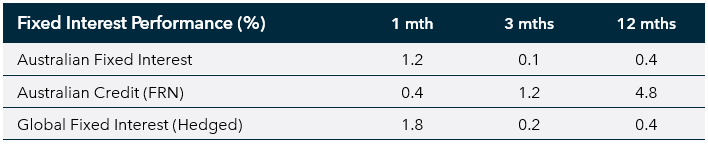
Source: Bloomberg, as at 31 October 2026. Index returns, before fees. Past performance is not a reliable indicator of future performance. Australian Fixed Interest: Bloomberg AusBond Composite 0+ Yr Index. Australian Floating Rate Credit: Bloomberg AusBond Credit FRN 0+ Yr Index. Global Fixed Interest: Bloomberg Global Aggregate Index, hedged to AUD.
Are we approaching the peak in interest rates?
On 3 November, the RBA raised the cash rate by 0.25 percentage points to 4.85%, its highest level since 2008. However, there are signs the end of the tightening cycle may be approaching. The decision was not unanimous. Six of the nine Board members voted to raise rates, while three preferred to leave them unchanged. The RBA also removed wording from its statement that signalled further increases may be needed, and its economic forecasts assume the cash rate will peak near its current level. Further increases remain possible if inflation surprises on the upside, but the bar now appears higher.
Higher borrowing costs are increasingly affecting Australian households and businesses. Mortgage repayments have risen, house prices have softened, and household spending is under pressure. Because Australian households carry relatively high levels of debt and most mortgages have variable rates, each rate increase flows through to household budgets quickly. Even so, monetary policy works with a lag. The rate rises already delivered will take time to fully slow the economy and bring inflation down.
The outlook is less clear in the US, where economic activity has remained resilient, and the US Federal Reserve (Fed) has raised rates only once in this cycle. Ongoing inflation pressures, heavy government borrowing and strong investment spending could keep US interest rates and bond yields higher for longer.
What could a turning point mean for bond returns?
Rising yields have been challenging, but they have also created a more attractive starting point for future returns. The broader Australian fixed interest market (Bloomberg AusBond Composite 0+ Yr Index) offered a yield of around 5.3% at the end of October, well above its 10-year average of 2.9%. This higher income provides a stronger foundation for returns and a larger buffer against further price falls.
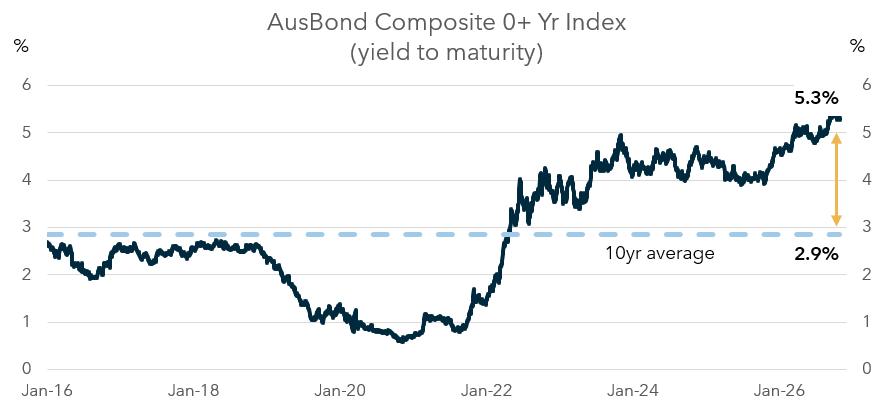
Source: Bloomberg, as at 31 October 2026. Australian bond yields are well above their 10-year average, providing higher income and a greater buffer against price falls.
If bond yields stabilise, investors benefit from the higher income now on offer. If yields fall, existing bond prices rise, adding capital gains to that income.
Bond yields can also fall before the RBA cuts rates, because markets look ahead. Investors begin pricing in slower growth, easing inflation and future rate cuts well before they happen. October may have offered an early example. Australian and US government bond yields both fell during the month, helping Australian fixed interest return 1.2% and global fixed interest 1.8%. One month does not make a trend, but it shows how quickly bond prices can respond when expectations shift.
What if the turning point is delayed?
Energy prices, including any further disruption linked to the conflict in the Middle East, remain a key risk to the inflation outlook. If inflation proves more persistent than expected, bond yields could rise further as markets price in higher interest rates for longer, and the RBA could raise rates again. In that case, bond prices may fall in the short term, although today’s higher income would offset part of the decline.
Where do we see the best opportunities?
Higher starting yields have improved the outlook for fixed interest generally, but opportunities differ across markets.
Australian government bonds: Our preferred exposure. If growth slows in 2027 and yields fall, these bonds could deliver stronger returns and provide valuable protection if economic conditions weaken.
Global government bonds: Global government bonds, including US Treasuries, offer attractive income after hedging currency exposure back to Australian dollars. However, greater uncertainty around US inflation, how the Fed will respond, and government borrowing supports our preference for Australian government bonds. Global exposure remains important for diversification.
Corporate bonds: Corporate bonds offer attractive income, but the additional return above government bonds remains modest. We favour higher-quality borrowers and take a more cautious approach to lower-rated companies, where the extra income does not fully compensate for the risk of default.
What does this mean for investors?
Apart from a stronger October, recent fixed interest returns have been disappointing, especially given the defensive role these investments play in portfolios. However, the same rise in yields that weighed on performance has also improved the outlook for future returns.
The timing of the interest rate peak remains uncertain, but we believe the balance is shifting in favour of bonds, especially Australian government bonds. Investors are now paid well above the past decade's average to hold high-quality bonds, while slower growth could support a recovery in bond prices.
Fixed interest continues to play an important role in portfolios, providing income, diversification and protection during periods of economic or share market weakness, as seen in October when bonds rose while global shares fell.
We’re here to support you through all market conditions. If you have any questions or would like to discuss anything about your portfolio in more detail, please don’t hesitate to reach out.
General Advice Disclaimer: The information contained in this article is general in nature and does not take into account your personal objectives, financial situation or needs. Before acting on any information, you should consider its appropriateness having regard to your individual circumstances and seek professional financial advice where appropriate.
Any opinions, forecasts or projections are based on information available at the time of publication and may change without notice. Investment values and returns can rise or fall, and past performance is not a reliable indicator of future performance. No investment returns are guaranteed.